A year ago Maple had $2.55B in AUM. Today it's $4.6B.
That's 81% growth in 12 months, and the curve is still steepening as new partners and chains come online. Yet many of the questions we see right now are about the token. Where are the Syrup Strategic Fund (SSF) buybacks? What does SYRUP actually do? How does value reach the people who hold SYRUP? I see versions of these every week. They’re fair questions, and deserve to be answered clearly and in one place. So here it is: how Maple is built, where the revenue goes, why we reduced buybacks this year, and what changes now.
One token, and no one sitting above
Most protocols put a separate equity layer above the token. Venture investors hold shares in an operating company with its own governance rights, and token holders have no seat at that table. In practice, that puts two groups on opposite sides.
We built Maple differently, from day one. Since 2019, every fundraise we have conducted has been into the protocol token (SYRUP). There is no separate cap table with superior rights and no external equity class that could steer Maple independently of the community. A venture investor, a Maple employee, and someone who bought SYRUP on an exchange yesterday all hold the same token. That is intentional, and it has been that way since the start.
There is one token, no matter where you sit in the stack. So when people ask who the team ultimately answers to, equity investors or SYRUP holders, the answer is simple: there is no separate equity to be conflicted with. When we act in the interest of SYRUP, we are acting in our own interest too.
The structure behind the alignment
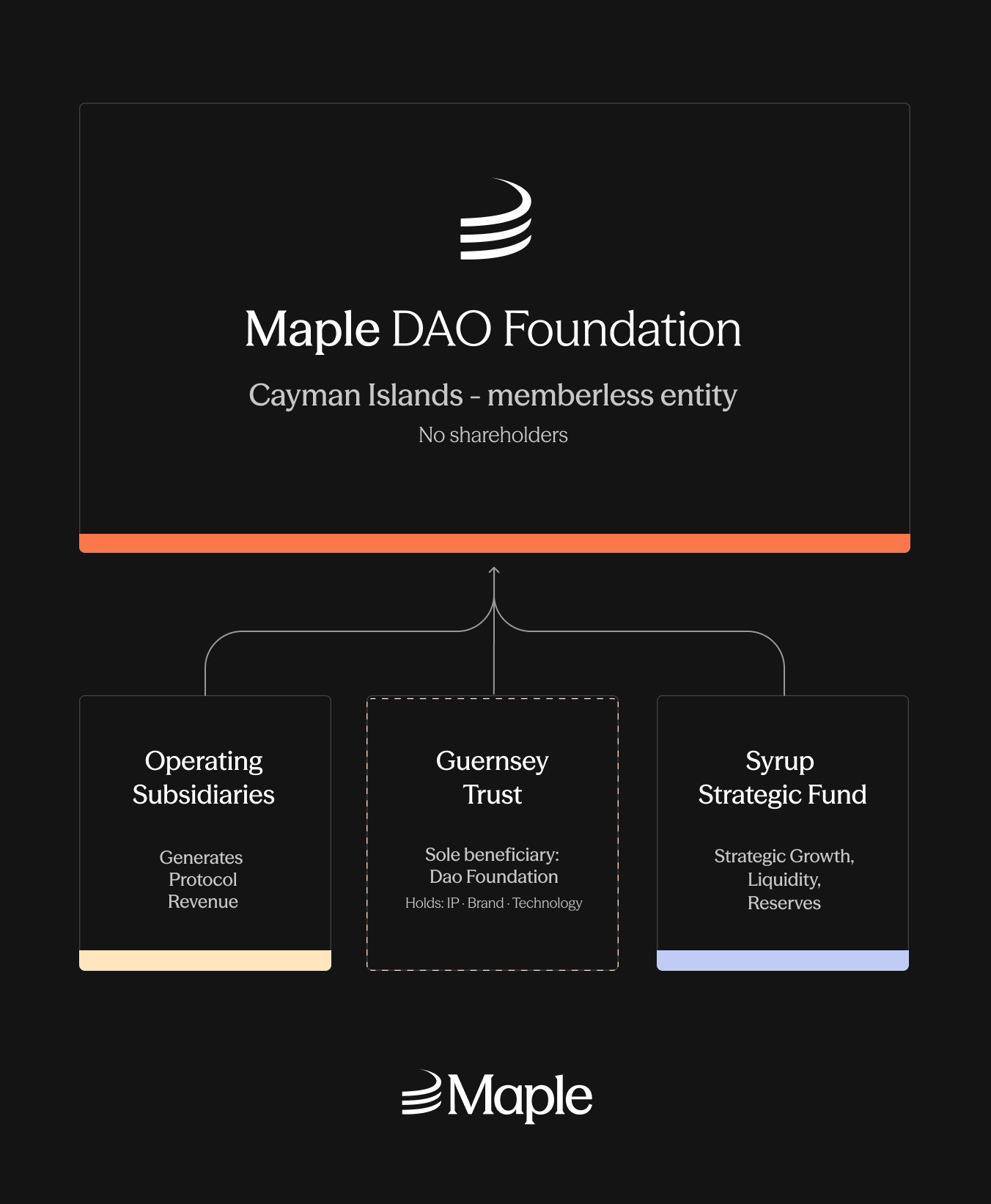
At the top of our corporate structure sits the Maple DAO Foundation, a Cayman Islands foundation company with no members or shareholders. All Protocol revenues flow up to the Foundation through its operating subsidiaries. No external equity sits above the structure.
We also placed the brand, IP, and technology into a Guernsey trust, with the DAO Foundation as its sole beneficiary. The software, the brand, and the intellectual property built over seven years are held inside a framework designed to keep them from being redirected to a private entity outside the token-holder community.
The result is simple: the revenues, technology, and brand all sit within a single framework, with a single ultimate beneficiary. That framework matters because it determines where every dollar of revenue ends up, which is worth walking through on its own.
Where the revenue goes
All revenue flows up to the Foundation. From there, it moves through two connected pools.
The Syrup Strategic Fund (SSF) receives 25% of all monthly revenue, as SYRUP holders voted through governance [MIP-019] in 2025. It is Maple's protocol treasury: the working capital behind growth, token liquidity, reserves, and buybacks. Its mandate is covered in detail below.
The Maple Treasury is where SYRUP bought back from the market is held. Tokens that enter the Treasury come out of circulation, so every remaining token represents a larger share of the network.
Value reaches SYRUP holders through both routes. Buybacks shrink the circulating supply. Reserves work differently but to the same end: capital retained by the SSF is held within the Foundation, so as those reserves grow, the balance sheet strengthens. Either way, no revenue is diverted to a separate company along the way, it stays within this structure.
What the Syrup Strategic Fund does
In 2025, SYRUP holders voted through governance [MIP-019] to create the Syrup Strategic Fund (SSF). With no separate equity structure, the SSF is designed to operate in alignment with the token-holder community, and its capital does three jobs:
- Strategic growth. Capital to keep Maple on the front foot: acquisitions, partnerships, integrations, and new chains that grow SYRUP and the wider ecosystem.
- Token liquidity. Resources that support healthy, deep markets for SYRUP across centralized and decentralized venues.
- Capital reserves and buybacks. A diversified balance sheet including SYRUP, stablecoins, and other liquid assets that lets Maple operate through a full cycle without forced selling or emergency raises, alongside buying back SYRUP from the market.
The SSF is designed to benefit SYRUP holders, with potential value accruing whether capital is allocated to buybacks or reserves. A buyback is one visible tool, but not the whole story.
Why buybacks were reduced in 2026 - and why that isn’t the same as value leaving
In 2025, the SSF bought back 8M SYRUP from the market. So far in 2026, we have executed limited buybacks totalling 2.5M, which has been a deliberate decision.
The SSF's mandate was intentionally broad. It set aside 25% of revenue for buybacks and for building a durable DAO balance sheet, without locking us into a fixed monthly buyback schedule. That flexibility lets us make the best balance-sheet call at each point in the cycle.
This year, we chose to strengthen reserves. We wanted Maple to withstand a prolonged downturn and keep scaling without ever raising emergency capital or selling into weak markets. That reserve strength is exactly what lets us keep investing and winning while others pull back. With hindsight, I know it was the right call for Maple's long-term health.
A quiet period on buybacks does not mean the SSF stopped working for SYRUP holders, but we do understand that without transparent reporting on how that capital was deployed, it’s difficult for the community to understand the full picture.
What changes
Three things are changing, and they’re designed to replace discretion with rules and visibility.
First, a transparent, rules-based model. We are bringing a governance proposal (MIP-021) to the community that would tie buybacks directly to Maple’s growth: as revenue scales, so would the buyback, driven by a defined formula you can verify. The forum discussion and the SYRUP-holder vote will open shortly, and we’ll be active in the thread to answer questions.
Second, a transparency dashboard. An on-chain dashboard where you can see revenue allocated to the SSF, its balance and asset mix, and buybacks.
Third, a real reporting and communications cadence. Monthly updates and a monthly Maple Memo (via email, TG and the blog), a monthly community AMA, and a quarterly Ecosystem Update Call (previously the Token Holder or Investor Call) within the first two weeks after each quarter-end. The question form will remain open at all times, and we’ll answer what you raise in the next Memo, AMA, or call.
The bigger picture
None of this structure is new. We’ve been building toward it deliberately since 2019, through multiple cycles and an evolving business, and the founding philosophy has never changed: the Maple team and token holders should be transparently and structurally aligned.
That foundation is what enables the next phase of growth for Maple. New chains, new integrations, major fintech and institutional partners, and products that open Maple’s markets to a far broader base. Every one of these runs inside the same aligned system, so as Maple grows, that growth has nowhere to go but to SYRUP holders. You shouldn't have to piece together what's happening with SYRUP from a product announcement or a forum reply. We haven't always made that easy. We're fixing it.
We update our token holders regularly. Sign up to receive updates directly from the Maple team, and add your questions ahead of the next Ecosystem Update Call or AMA Call.
Disclaimer: This post explains how Maple is built, but it isn't an offer, a solicitation, or investment, legal, or tax advice, and it isn't a promise that SYRUP will go up. The plans described, including the buyback model, depend on the SYRUP-holder vote, market conditions, and applicable law, and so may be subject to change.

Joe Flanagan
Chairman and Co-Founder
Joe Flanagan is the Co-Founder and Executive Chairman at Maple. Joe is responsible for Maple's overall strategy and growth.