
Picture a market town in Mesopotamia, roughly four thousand years ago.
A farmer needs seeds to plant this season's barley. He doesn't have it. A neighbour does. What happens next, whether that neighbour hands over the grain, on what terms, and what happens if the harvest fails, is the entire history of lending in miniature. Strip away the technology of any given century, and this is still, at its heart, the transaction every bank, every fintech, and every crypto protocol is trying to make work at scale.
I've read into this history because it helps us understand something I care about a great deal in today’s society. Every generation has faced the same handful of problems, trust, risk, default, liquidity, and solved them with whatever infrastructure it had at the time, and each solution eventually looked primitive to the generation that inherited it. I think we are living through the next entry in that same sequence. This is my attempt to place what we are building at Maple inside that longer arc, instead of presenting it as something that simply appeared out of nowhere.
What made that first exchange possible was something more specific than trust: Enforcement. The farmer and his neighbour may well have trusted the other’s character. But personal trust doesn’t make the debt enforceable if the harvest failed, or if the neighbour simply decided not to pay it back. To make that possible, everyone in that town had to share an understanding that the grain belonged to whoever held it, and that a debt, once agreed, would be enforced regardless of how the two men felt about each other.
Keep the concept of contract enforcement in your mind throughout this article because it’s a pivotal concept. Property rights come first. Trust between strangers, the price of risk, what happens when a borrower can't pay, whether a lender can get their capital back, all of that is built on top. Every era of lending has faced the same handful of problems.
What has changed, era to era, is only the tool used to solve them.
From villages to nations
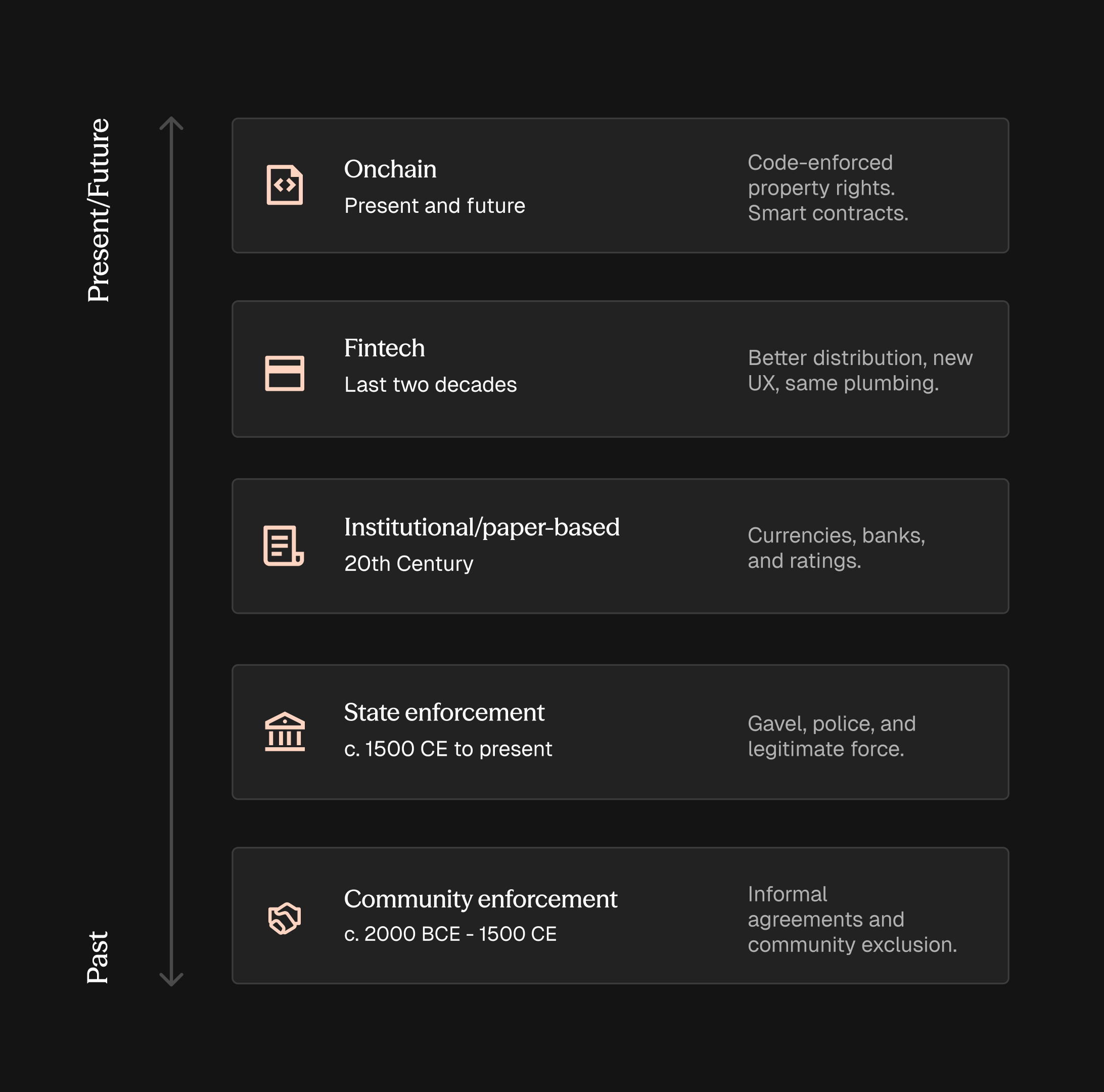
Owning something and being able to enforce your ownership are entirely different things. In that Mesopotamian village, enforcement came from the community's willingness to punish anyone who broke the agreement, through exclusion, restitution, or force. As lending outgrew the village, the way we enforce needed to scale with it, eventually concentrating in the state. Courts, police, and a monopoly on legitimate force, have stood behind every contract since. That enforcement mechanism, not the idea of property itself, is what changes later on.
For most of history, lending stayed local because it had to. A farmer lending grain to a neighbour, a merchant extending credit to another he saw every week at market, none of this required lending to a completely unknown person, because there were, in the relevant sense, no strangers, and the community itself was the enforcement. Land was often the first real collateral, for the simple reason it couldn't be hidden or carried off.
As trade grew beyond what any village could absorb, informal enforcement stopped being enough, and each period built new infrastructure, and new concentrations of authority, to replace it. Sumerian temples kept written records of grain and silver loans. The Code of Hammurabi set out some of the first formal rules on interest and default. Centuries later, Italian merchant banks began lending not just to other merchants but to kings, a new check on royal power, alongside the religious head, and armies. Double-entry bookkeeping gave a lender in one city a way to assess a borrower's finances in another, without ever meeting him.
By the twentieth century, this had scaled into something close to a natural endpoint for the paper-based era: National currencies, national regulators, and capital markets deep enough that a single country, the United States, came to account for more than half the world's capital market activity. That depth was real, and it funded a great deal of genuine growth and industrial advancement. It was also incredibly narrow on the world stage. Sophisticated, well-priced credit was available to a few hundred million people inside a handful of developed economies, and to almost no one else.
The events of 2008 are usually told as a story about excessive financial engineering. A more precise version is that the loans behind the crisis were simply bad, and packaging them differently was never going to change that. The real failure sat one level up: Judgment on the quality of those loans was concentrated in a small handful of ratings agencies, and their errors went unquestioned for far longer than they should have, because too few people were positioned to check the work.
What fintech changed, and what stayed the same
The assumption after 2008 was that banks would simply absorb the lesson and carry on much as before. Regulation constrained them instead, and a new set of competitors moved into the gap. Private credit funds grew to serve institutions and wealthy individuals. Further down the market, fintech companies spent the following two decades building better distribution and better products for ordinary depositors, who had spent generations earning next to nothing on their savings while banks kept most of the difference for themselves.
Fintech did this largely without touching the underlying plumbing. Settlement between institutions was still slow. What sat behind a loan was often still opaque to the people ultimately funding it. Fintech made borrowing and saving easier to use, while the infrastructure underneath the interface stayed largely as it was. That distinction is worth pointing out because the infrastructure layer is precisely what onchain lending is now trying to rebuild.
Property rights, enforced by code
Onchain lending refers to loans issued and enforced using a blockchain, a shared, public ledger that many computers maintain together, rather than a single bank's private database. The rules of the loan are written into a smart contract: Code that carries out its own terms automatically, releasing collateral or triggering a repayment without needing a bank employee, or the borrower's cooperation, to make it happen.
Historically, extending trust to a stranger meant leaning on a substitute for actually knowing them: A credit score, a recognisable institutional name, or an implicit government guarantee. A smart contract offers a more direct substitute. The property rights over an asset are enforced by code rather than by an institution's word. Put simply, trust becomes something closer to a technical fact than a judgment call.
This is where the enforcement question gets a genuinely different answer, though only partly. Enforcing a claim has always required someone holding a monopoly on force in reserve, be that a village elder, a court, or a police officer. For a purely onchain asset, a stablecoin balance, a crypto lending position, a smart contract genuinely replaces that: If this condition is met, release the asset to me. Borrowing against a real-world asset is different. A token can represent a claim to a house, but it cannot stop someone from occupying it, and it is only as good as whatever local court is willing to recognise it. That side of the story still depends on the same enforcement it always has.
Bitcoin was the first real proof that this idea could work at scale. It is often compared to gold, and the comparison is useful. Both are scarce, and a unit of either is interchangeable with any other unit of the same size. But Bitcoin improves on gold in one specific way. Physical gold has to be stored somewhere, and the moment it sits in a vault, its owner has taken on the risk of whoever runs that vault. Bitcoin only requires access to the blockchain and control of your own private key, with no custodian standing between you and the asset, which is what makes it, in practical terms, an unusually clean form of collateral.
What followed Bitcoin has moved in a fairly consistent direction, and the sequence doubles as a rough map for where things are headed. Other crypto assets came next. Then came tokenization, the process of representing ownership of something as a digital token that can be tracked, transferred, and used as collateral on a blockchain, applied first to crypto-native projects themselves. The current stage is extending that same process to real-world assets: Equities and bonds first, since they are already liquid and relatively simple to represent this way, with harder assets such as real estate likely to take considerably longer, since a token is only as good as the legal system that recognises the ownership behind it, and the insurance that guarantees it.
Stablecoins, digital tokens designed to hold a steady value, usually one US dollar, sit in the middle of this progression. A dollar sitting in a bank account is, legally, the bank's dollar, a claim you can redeem rather than an asset you directly hold. A dollar held as a properly structured stablecoin is also a claim but on the issuer's reserves rather than a bank's balance sheet: Reserves that are meant to be held separately, in safe, liquid assets, rather than lent out and mixed with everything else the institution owns.
People tend to adopt stablecoins in a fairly predictable order: First for payments, then for yield once they realise the balance can earn something, then, as more of what they own becomes tokenized, as collateral against which they're willing to borrow.
What onchain data actually fixes
Putting loans onchain leaves the underlying credit decision exactly as it was. A bad loan recorded on a public ledger is still a bad loan. What changes is who gets to look at it, and when. Distributing that judgment changes the picture. A system where loan performance, collateral levels, and repayment data are public by default means far more people can form a view, and form it earlier. Analysts, competitors, and increasingly automated tools are being built specifically to monitor risk at a scale no ratings desk ever could. That capability only grows as AI systems get better at reading exactly this kind of data, which makes public, structured lending data more valuable over time, not less.
There is a genuine tension underneath this, though, once lending moves past simple crypto collateral and into real-world borrowers: transparency and privacy pull in opposite directions. Nobody wants their income, health records, or repayment history published for anyone to see. The most promising answer here is a technique called zero-knowledge proofs, which allow a system to confirm that a borrower meets a stated condition, sufficient income, an acceptable credit history, without exposing the underlying data itself. It's the closest thing available to getting the benefits of public verification without asking anyone to give up their privacy to get it.
Where this goes next
The more interesting shift underway is fintechs, the same firms that spent two decades competing with banks on distribution and user experience, gaining the infrastructure to compete with them on the underlying product as well. This is where a company like Maple sits: providing the stablecoin lending infrastructure that generates yield, and passing that yield through to the fintechs and platforms holding the actual customer relationship, so they can offer a meaningfully better product without having to become a lender themselves.
There is a version of this story where none of that actually matters. The infrastructure arrives roughly on schedule, ledgers become public, and the industry treats transparency as a technical upgrade rather than a change in how anyone behaves, quietly running the same old practices over newer rails. That outcome is entirely plausible, and comfortable for the institutions that already dominate the current system, since adopting new technology is far easier than giving up the opacity that has always protected them from real competition.
A different outcome, one where a saver in Lagos can access the same yield as one in London, and where a lender's book can be checked rather than taken on faith, does not follow automatically from the technology existing. It takes a handful of firms choosing transparency before regulation or competition force the issue, and continuing to choose it when doing so is inconvenient. That is the choice we are making at Maple, on the view that being genuinely harder to copy, not simply first to market, is the only durable edge against incumbents who would rather things stayed as they are.
Capital markets that once served a few hundred million people in a handful of developed economies are gradually being rebuilt as something closer to global infrastructure, open to anyone with an internet connection rather than gated by geography or net worth. Property rights, enforced this time by code, are what make that possible. Which version of that future actually arrives is not decided in advance.
Four thousand years ago, a farmer and his neighbour worked out how to trust a debt without needing to trust each other completely. We are, right now, working out how to do the same thing for the rest of the world, at a scale no village, bank, or nation ever managed alone. I think we will get there. We intend for Maple to be one of the reasons why.

Martin de Rijke
Head of Growth
Martin leads growth strategy at Maple, having grown the platform's assets under management past $4.5 billion and built the distribution and partnership strategy behind syrupUSDC and syrupUSDT, including integrations with Aave, Morpho, Pendle, OKX, and Binance Web3 Wallet.