
Dave Beach
Editorial & Communications Lead
"The big is always made of the small."
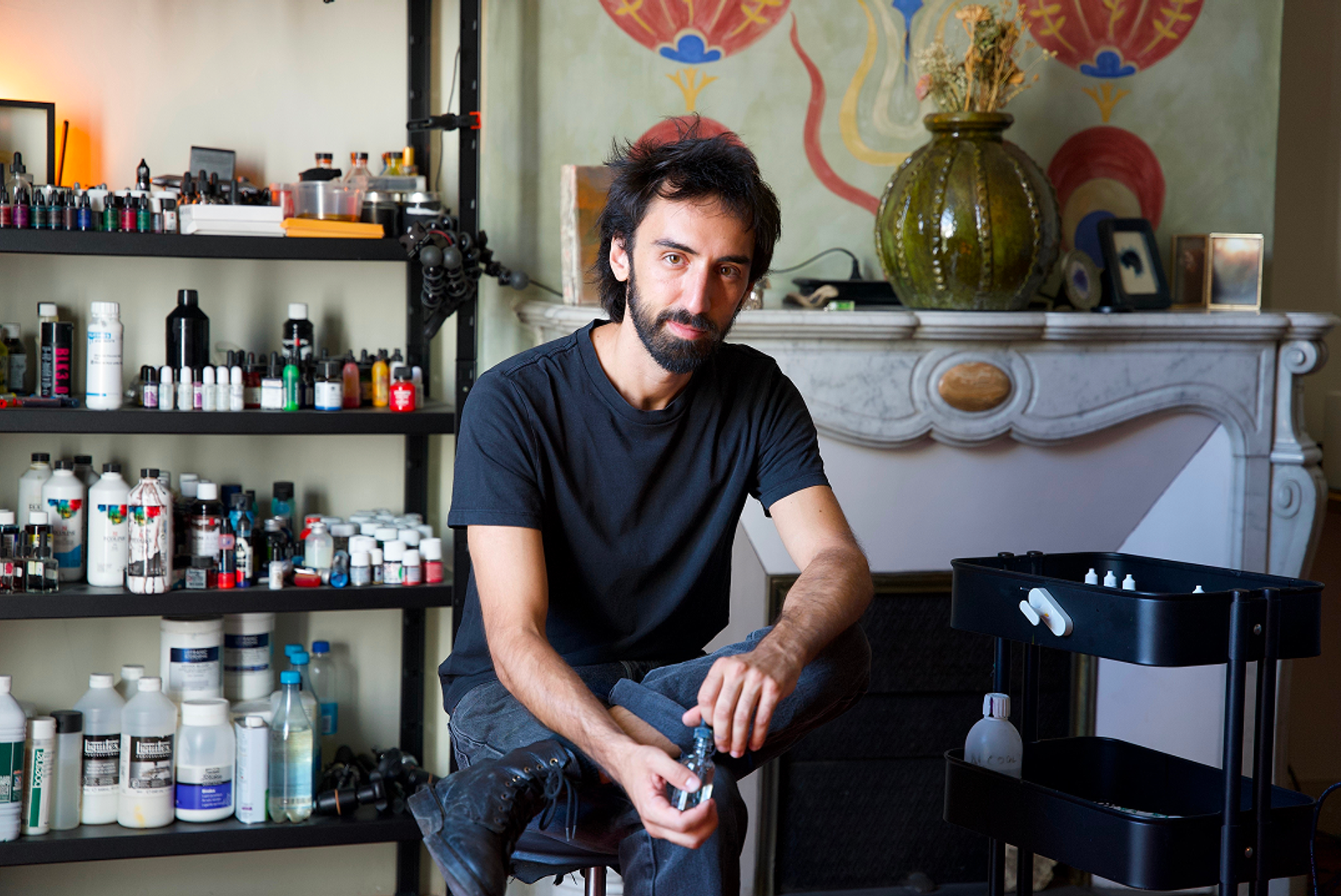
That was the answer Roman Hill gave the first time we met him, over a video call, when we asked why he films the very small rather than the very large. He grins as he says it. Behind him, you'd think he had a virtual background labeled La Belle Bohème, but that is the warm glow of his Marseille studio, with a range of his finished and not-quite-finished work on the walls behind him. Everything feels splattered in paint, a creative oasis, and its maker beams back at us.
Roman in his studio, 2026.
You might wonder how the brand team of an onchain asset manager came to speak to an artist in a high-ceilinged 1850s Marseille townhouse.
It all started with a tagline.
Most marketers will tell you that landing on a tagline that everyone agrees on is close to impossible. And yet, we arrived at ours remarkably quickly when we sat down with our co-founders for the first of many sessions to review the brand because the business had outgrown the existing narrative.
"Onchain Capital. Activated." You've probably seen that line sign off our content and design in recent months.
Head of Marketing Natalie Williams has written about why we're evolving the brand. The short version: Dormant capital fails everyone, and Maple exists to activate it and put it to work. The tagline gave us the words but we needed help visualizing the concept.
We also knew what we didn’t want that picture to be. More of what people see every day is now generated, rendered, or optimized by AI, and finance is moving in the same direction. It’s exactly why we wanted the image at the center of our brand to be something that physically happened: Real material, real light, and a real reaction, captured once and not invented.
Stepping outside crypto's usual look
When banks, fintechs, and crypto companies want to reach people beyond their immediate circle, they usually turn to culture, and most often to sports or music. Think stadium naming rights, F1 team sponsorships, and festival stages, to name a few.
We chose art.
That’s because crypto has a familiar look: Dark screens, glowing gradients, 3D renders, and more and more images generated by AI. Most brands in our part of finance now live on screens, and many hand their creative work to software. People are growing tired of it. Feeds fill up with generated images that start to look alike, made and remembered by no one in particular. When nothing is crafted, nothing feels intended, and a brand that looks like everyone else’s struggles to say anything about purpose.
We wanted to step outside of that digitally artificial world and take our brand back to analog. Maple sits between worlds: Traditional credit and onchain rails, digital records and the real businesses they fund. A brand built on capital moving through the real economy couldn't sit on a flat color or a rendered gradient, so we stopped designing the centerpiece ourselves and commissioned an artist instead.
We also wanted that human craft to run through everything we produce, as a reminder of who we ultimately do the work for: The people whose capital we put to work and the businesses it helps grow.
Meet Roman Hill
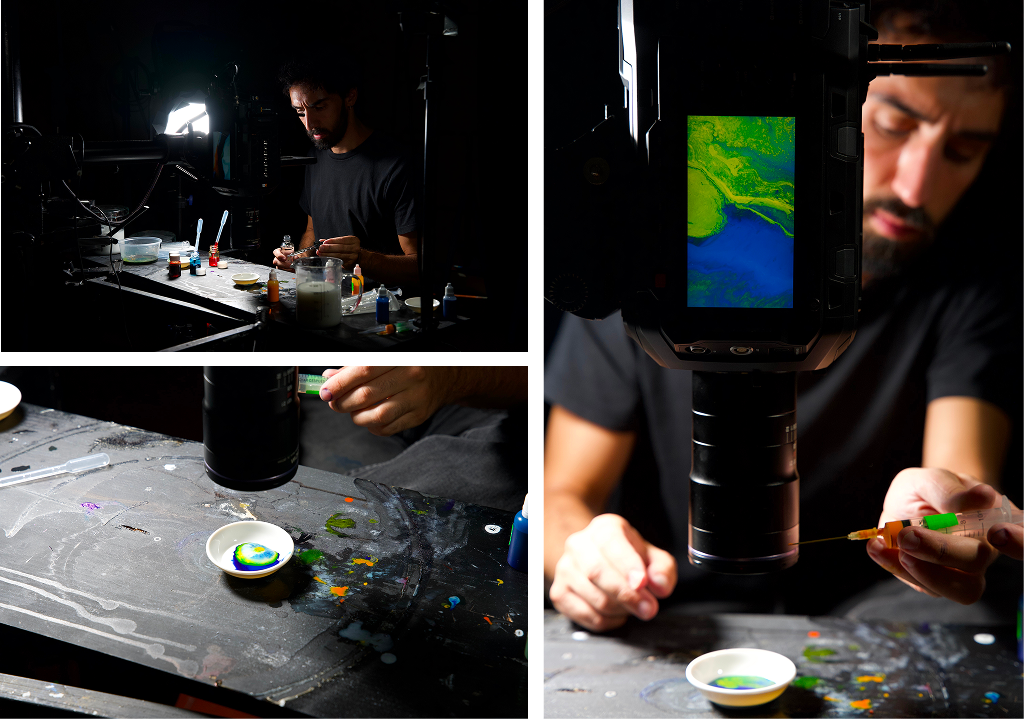
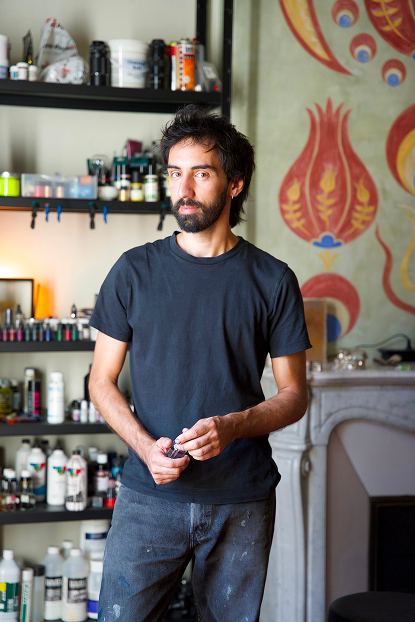
Roman experimenting with color for Maple, 2026.
Roman films chemical reactions and optical phenomena at micro scale, in slow motion and on camera. There’s no CGI and no AI in his work. In our brief to him, we put it this way: A captured reaction holds a truth that a rendered gradient never will.
His fascination started early, with a magnifying glass and the tiny lives of ants in his garden. When he got his first camera 12 years ago, he modified the lenses straight away and began mixing liquids, inks, and chemicals, sometimes setting them on fire to see what happened. Only after his grandfather died did Roman learn that he had worked for NASA on the first Moon landing and the Viking missions to Mars, and had spent his career under a microscope. One generation reached other worlds by looking closely at small things. The next is doing the same with a modified lens.
"I don't really have a scientific background. I just tried things," he says. "The things you couldn't anticipate, the things you couldn't control, were the things that made it art."
Each piece starts with up to two hours of preparation. He tunes every parameter and clears every speck of dust from a setup about two centimeters wide. "Then I drop one drop, and this is a universe I don't control anymore," he says. "But it has all the context I could control."
Anyone who works in credit will recognize that last line. Underwriting is the same discipline. You control the preparation, the structure, and the terms. Then the loan goes out into a market you don’t control, carrying every decision you made before it left.
Patterns at every scale
Roman is clear that markets aren't his field. "I don't know anything about economics. I don't know anything about crypto," he says. "But what I understand are those patterns of interconnection, at different scales."
Those patterns run through his work. The same fractal shapes appear in a river delta, a tree, and the networks that feed galaxies. "The immensity of the big scale is made of the small scale," he says, "and it shares the same language."
We see the economy the same way. Its smallest unit is a single credit decision: One lender, one borrower, and capital that would otherwise sit still meeting a business that needs it. Together they produce something neither had alone. A growing business, a liquid market, and the yield behind a dollar in a banking app all trace back to that original reaction.
That is the work Maple does. We underwrite each of those loans on its own terms, size it to its risk, and repeat the decision. The larger system is built from those decisions, which is why Roman’s work felt less like a metaphor for Maple and more like a picture of it.
At the heart of the final work which you can see below, a single drop falls into a field two centimeters wide and sends an impulse outward, with deliberate structure forming as it spreads. It now runs behind our name and our products. What you see below is that outward impulse captured at the microscopic level. The big, as Roman says, is always made of the small.

Maple canvas, Orange

Maple canvas, Mist
Coming soon: A limited edition from the Maple series
Roman’s work was made to be looked at closely, not only glimpsed behind a logo. So we’re working with him on limited-edition artwork drawn from the Maple series, taken from the original footage of the reactions you’ve seen in our brand. Each piece will be one of a small, fixed number, made from a moment that happened once and can’t be repeated.
Dave Beach
Editorial & Communications Lead
Dave runs content and communications at Maple, drawing on a decade in fintech and finance. Dave started as a banking trade journalist and went on to build out the content and communication strategies at leading fintechs.