
Natalie Williams
Head of Marketing at Maple
Capital matters because of what it makes possible. When a business can borrow, it hires, buys inventory, and opens new markets. When a trading firm can borrow, markets stay liquid when they need it most. When a dollar in a banking app earns, it's because a business somewhere is growing and paying interest on the capital behind it. Activated capital sets things in motion: Borrowers build, businesses expand, lenders earn, and economies grow.
Yet too much of the world's capital is held back. Credit takes months to arrange, depends on where you're based, and sits in systems nobody outside the lender can check. But those are symptoms of a deeper problem. That deeper problem is a mindset that's comfortable keeping finance closed and letting capital sit still.
Maple exists to change that. We put capital to work where it creates growth, and we do it onchain, where anyone can see what we've lent and what backs it.
This is the principle Joe and Sid founded Maple on seven years ago, and it hasn't changed. What has changed is scale: Our business has outgrown the brand that described it. So we've put this idea at the heart of our updated brand, which starts rolling out this week.
Where finance is going
Traditional finance, crypto, and fintech are converging into a single market. Asset managers that stayed away after the crypto challenges of 2022 are building for this new converged market, and now Wall Street and fintech are arriving. We see that as validation, because they're arriving on ground Maple has worked since 2019.
Maple doesn't bridge the old world and the new. We're native to where they meet, combining institutional credit discipline, onchain rails, and fintech's reach in one place.
You can already see it in who works with Maple:
- Robinhood customers hold a dollar backed by the loans we underwrite, so a consumer app runs on institutional credit.
- Kraken funds part of its lending to trading clients through us.
- A Wall Street firm works with us on Bitcoin-backed lending.
- Robinhood, Coinbase, Kraken, Bitwise, Anchorage, BitGo, OKX, and Zodia all lend to, borrow from, or build on Maple.
We've originated more than $25B, and by 2030 we plan to reach $100B. By then, the dollar in your banking app, the loan behind a growing business, and part of a Wall Street firm's balance sheet will sit on the same open infrastructure at far greater scale. Anyone will be able to check what backs their money, and Maple will be the engine underneath it.
How Maple activates capital
Maple is an onchain asset manager that activates capital through lending and trading. There are three ways in, all powered by one onchain engine:
- Maple Earn is for retail and institutional lenders who want to lend through Maple and earn yield generated by economic activity.
- Maple Credit is for institutional borrowers who want bespoke credit against their assets instead of selling them, with facilities funded in as little as seven days.
- Maple Embed is for fintechs, wallets, exchanges and protocols that want to put Maple inside their own products. More than 50 partners already build on it.
Most people will meet Maple through Embed: Inside an app they already use, often without realising Maple is behind it.
Every product runs on our allocation engine, which deploys capital across independent strategies, each with its own limits, and onchain reporting. We recently announced three new strategies built to generate returns through different market cycles.
Our risk management draws on experience in traditional credit, built into smart contracts and our own systems:
- Loans are backed by collateral worth more than the loan.
- Margin thresholds are agreed upfront and monitored in real time, and both sides can see them.
- Every loan is recorded on a public blockchain, and Maple Transparency shows what we lent, to whom, and what backs it.
Every return at Maple has a source you can check. Most of it is interest paid by businesses using credit to grow, not incentives or token emissions. In Q2 2026, syrupUSD assets returned 1.1% more than comparable products, with no incentive programme.
Where we came from
Sid Powell and Joe Flanagan came from corporate lending and debt markets. When they started Maple in 2019, they saw two systems that didn't fit together. Traditional finance managed risk well but disclosed very little. Crypto put every transaction on a public record, but the lending often lacked real credit discipline. Maple was built to do both.
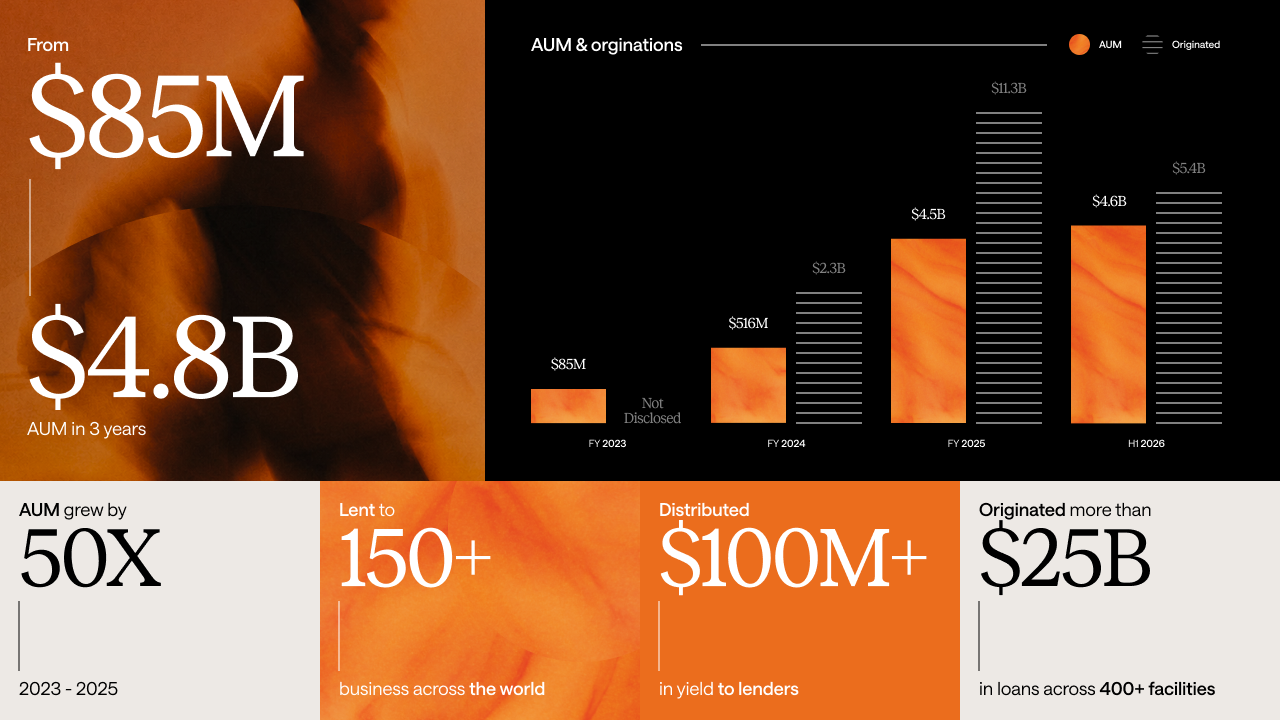
Since the end of 2023, Maple's assets under management have grown more than 50x, from around $85M to $4.8B today.
We've underwritten through full market cycles since 2019. In that time, Maple has:
- Originated more than $25B in loans across 400+ facilities
- Grown to $4.8B in assets under management
- Distributed more than $100M in yield to lenders
- Lent to more than 150 businesses
In the first half of 2026, lending across the rest of the market shrank by nearly a third, while Maple grew 22%. Earlier this year, syrupUSDG, the yield-bearing dollar Robinhood customers see in their app, took in $200M in eight days. Our standards stayed the same while access widened.
What's changing about our brand
When we started looking at our Maple brand refresh in 2026, I asked our partners, lenders, borrowers, token holders, and team how they'd describe Maple. Almost every group gave a different answer. The business had moved faster than the brand. We didn't need a new story, but a brand that tells the one we already have.

Our logo and Maple orange stay, because seven years of recognition and brand building with partners, lenders, borrowers, and token holders is invaluable and hard-won. Everything else changes between now and year-end, and the first assets roll out this week.
Capital should be activated. It's what we do every day, and what we've worked toward throughout our history. Now the brand says so, too.
Onchain Capital. Activated.
Natalie Williams
Head of Marketing at Maple
Natalie Williams is Head of Marketing at Maple, bringing over 15 years of experience scaling VC- and PE-backed companies across fintech, AI, SaaS, and consumer tech. Natalie has built marketing engines from the ground up across some of the most recognisable names in global fintech, including Airwallex, where she built the EMEA marketing function. Natalie leads the marketing strategy for the leader in onchain asset management, bringing institutional fintech credibility and a proven growth playbook to Maple.