
Dave Beach
Editorial & Communications Lead
Every October, the payments industry gathers in Las Vegas for Money20/20 USA. Banks, card networks, fintechs, and their suppliers spend four days on panels, the exhibition floor, and side events, and the agenda is a fair guide to what the industry will spend the next year building. This year, the two words that came up most were “AI” and “stablecoin.”
Maple was there because fintechs are a growing part of our business. More of them are moving money on stablecoins, and the balances that sit between payments are what Maple Embed puts to work. We went to meet partners and to hear firsthand how fintechs, banks, and payment companies are thinking about stablecoins.
Dave, who runs Editorial at Maple, joined us in June after a decade in payments, as a payments journalist and then at leading fintechs. This was his fifth Money20/20 and his first from the crypto side. He published these notes on his LinkedIn shortly after the conference, and we’re sharing them here because they cover the questions we heard most in Vegas. Where are stablecoins winning today? How are banks responding? What do agents change? And what happens to money while it waits?
Originally published on LinkedIn.

A payments marketer in a crypto lanyard
“We're an onchain asset manager. Lenders allocate funds to us for yield, and that yield is generated by the interest paid by borrowers,” I say.
I'm standing in the polished atrium of a high-end Las Vegas gym.
Maple is co-hosting a 45-minute bootcamp with fintech influencer Marcel van Oost's team just before doors open for day one of Money20/20, and the person who just asked what Maple does is recovering from the workout, water in hand. He raises an inquisitive eyebrow at my description.
It's one of the many side events that accompany Money20/20 USA, one of the biggest fintech shows in the world.
I sense I've just said some words that are tripping him up. I think I know which ones.
“We're a fintech,” I add. “Other fintechs come to us to embed yield on stablecoins, whether on their own reserves or in their own products for their customers. 50 partners already build on Maple Embed.”
His eyes light up as it clicks: Fintechs are already moving money on stablecoins, and the balances sitting idle between payments could become a sticky revenue stream.
I had quite a few conversations like that over the four days of conferencing. Of course, the response varied depending on how close each person's company was to the onchain space, but for the most part, I relied on my trusty fintech translation of Maple.
It wasn't long ago that I heard the same translation myself, when my Maple interviewer used it to explain the company's new fintech chapter.
I joined four months ago, coming from a long stint at Airwallex, the cross-border financial platform for businesses. I've spent a decade in payments, starting out as a financial journalist before moving to the “dark side” of in-house comms, content, and brand.
I joined Maple because it's one thing to make the movement of money better, but another thing entirely to put it to work and reimagine what credit could be and, more importantly, who can access it.
That fintech chapter is the part of Maple that excites me most. It's also why I've just spent four long days listening to panels, walking the exhibition floor, and going to networking events.
If you looked closely, the story of fintech in 2026 and 2027 was prewritten across the agenda before the first panel started. The two most used words on it? “AI” and “stablecoin.”
I've seen this cycle before
We had plenty of productive meetings with partners and others in the crypto-adjacent space. But a conference like this is also the best way to see where an industry sits on Gartner's hype cycle.
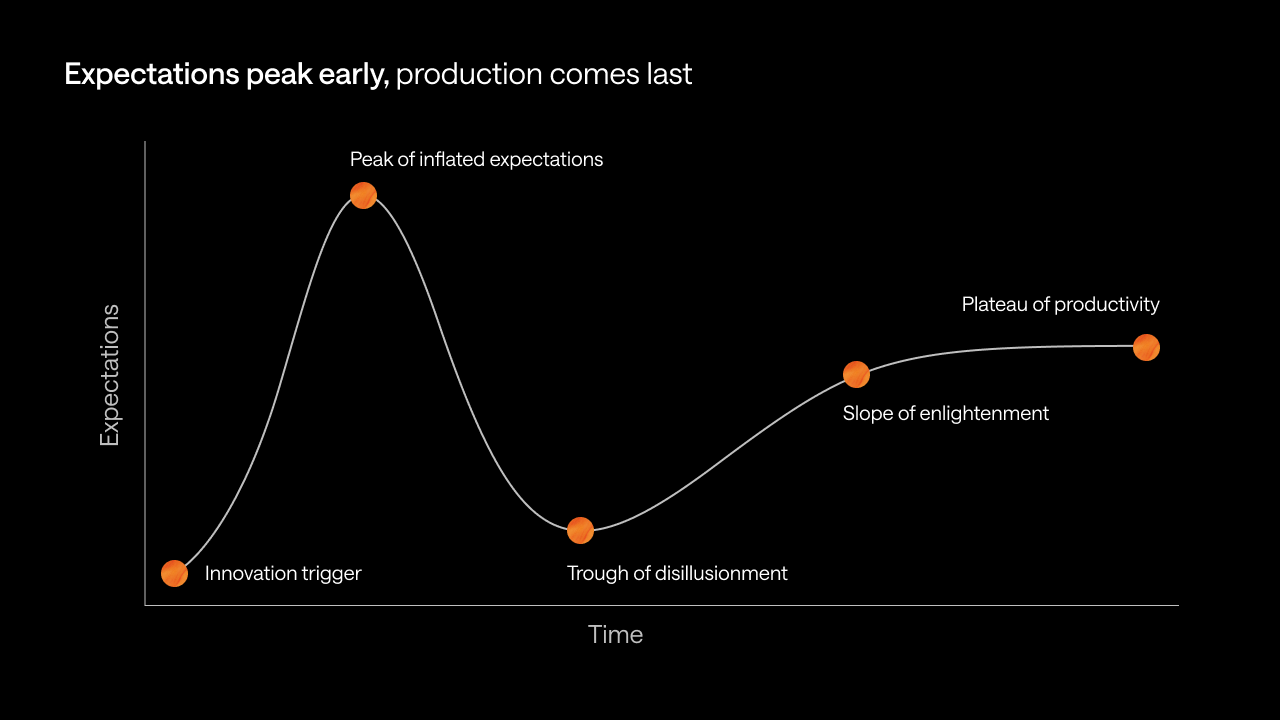
Gartner Hype Cycle · five stages
I've watched a few of these cycles from the payments side:
- Domestically, instant payments took off with Faster Payments, SEPA Instant, and Venmo.
- Cross-border was a different show. SWIFT, the network nearly every bank relies on, launched gpi to speed up international payments. Ripple, the upstart, ran its own conference in Toronto the same week as SWIFT's Sibos in 2017, and lined up branded cars outside the Sibos venue to ferry delegates across town. Subtlety has rarely been crypto's strong suit. A few months later, I landed an exclusive interview with Marcus Treacher, a SWIFT alumnus by then at Ripple, and Ed Metzger of Santander UK about the bank's plans to use Ripple for cross-border payments. Treacher's verdict on SWIFT's approach: "It's not about putting faster trains on the existing rail infrastructure. It's about building an airplane." The piece went viral, and Treacher's words still resonate nearly a decade on.
- Open banking let people pay straight from their bank account and share their account data with apps they chose.
- Wearable payments rode the tail end of contactless: I have one of very few pilot wrist watches between Barclaycard and Guess, with a BPay contactless chip inserted in the strap. Machine learning changed how banks and fintechs catch fraud. Biometrics made payment authorization far stronger, once the industry worked out how to collect that data ethically.
The point is that each followed a similar order.
The industry spent the first years on adoption, getting the rails built and trusted. Retention and monetization came later, once enough money was moving to build a business on top.
Stablecoins are in that first phase now.
Payments are driving stablecoin adoption today, mostly across borders. Agents could carry it into domestic finance next. And once enough money sits on stablecoins, the question becomes what that money earns, and what it costs to borrow.
For Maple's fintech strategy, that order matters. We work on both sides of the stablecoin money flow. Fintechs and treasuries holding stablecoin balances can earn on them through Maple, which gives their customers a reason to keep money in the app rather than moving it straight out. Companies that need capital can borrow it onchain, which is the business Maple was built on. Adoption brings the balances. Retention and monetization are where we come in, and the more money that moves on stablecoins today, the more there is to keep tomorrow.
Stablecoins definitely work. Now what?
On the panels I sat in, speakers spent little time arguing that the technology works or that adoption wouldn't follow swiftly. That was all assumed. They spent most of it on how to fit stablecoins into businesses that already run on banks, cards, and wires.
Maria Oldham, COO of Yellow Card, put it plainly on the "Stablecoins in the Wild" panel, which featured founders and operators who run stablecoin payment businesses across Africa, Asia, and Latin America every day. When she sits down with large corporates, she said, "the question is not whether stablecoin works for this." The question is whether a treasury team can "defend the solution in front of their CEOs, CFOs, auditors, and board."
That line stayed with me. In payments, a product rarely sells on what it can do alone. Like most B2B tech, it sells on whether the person buying it can explain it to the people who sign off.
The same panel gave that CFO plenty to work with. Kevin Lehtiniitty, CEO of Borderless, an orchestrator, said businesses that prefund accounts abroad carry a 6-9% cost of capital on that money, and topping up hourly with stablecoins could cut it by 90%. Same-day settlement would also remove a lot of capital wasted on fees along the way. His example, though there are many others, was a shipping port, where cargo waits for the wire to settle, costing about $200 per container per day. Five containers and a three-day wire cost $3,000 before anything leaves the dock. Multiply that across all the ports of the world, and you start to see the opportunity for wholesale innovation.
This was familiar ground. At Airwallex, I spent my time speaking to CFOs about how prefunding, correspondent banks, and days in transit add up. Port fees are one more of those costs. Airwallex and the Centre for Economics and Business Research put the total at $330B a year in working capital lost to inefficient cross-border B2B payments, a figure Airwallex calls the Global Growth Tariff.
Banks are now Borderless' second-fastest-growing customer segment, which Lehtiniitty admitted he didn't expect to be saying in 2026. David Nandwa of HoneyCoin made the same point from the other side of the table. Banks aren't going anywhere, he told the audience with a grin, nodding to the bankers in the room. "The reality is we still need the custodians, we still need the lenders," he said.
Banks' reaction to stablecoins was mixed, though. On the "Beyond the Hype" panel about B2B stablecoin rails, Jeffrey Wallis, CEO of full-reserve bank N3XT, said cost savings matter more to retail and small-business users than to institutions moving money at scale.
Ron Oliveira, formerly CEO of Revolut in the Americas and a banker for many years before that, was blunter on "The Last Security Gap in Borderless Payments" panel: "The banks have no interest in stablecoins." A stablecoin means holding reserves in full, with no fractional lending and no interest, which runs against how banks make money, he said. He expects them to back tokenized deposits instead. Erhan Tetik, who leads cross-border payments at Bank of London, was more guarded. Stablecoins make payments faster, he said, "but in the meantime it's quite crucial to understand where the money sits," and for him the safest answer is still a full-reserve bank holding deposits at the central bank.
The best advice to understand the banks’ position on stablecoins came from the "Regulatory Update" session: "Watch what they do, not what they say," said Cody Carbone, CEO of the Digital Chamber. Patrick Witt, until days earlier executive director of the President's Council of Advisers for Digital Assets, backed him up. Banks that voice reservations in public have still made key hires, he said, and JPMorgan, Morgan Stanley, and Goldman Sachs have all named heads of digital assets. Lip service, or genuine acceptance?
To win mass adoption, make stablecoins invisible
The panels kept coming back to one idea: The best stablecoin experience is one the customer never notices. Businesses don't want a new kind of money. They want money that arrives in seconds, at a price they can see in advance. Not much to ask, is it?
That's why companies like David Nandwa's HoneyCoin exist. The businesses they serve don't know how to open a stablecoin wallet, and "many of them don't even need to know that money is moving in stablecoins," David says. Corporates see it the same way. Sam Aarons, CTO of Modern Treasury, called stablecoins "another option in the menu," next to ACH, wires, and instant payments rather than in place of them.
It's how I learned to think about payments at Modulr. Every rail comes with its own hours, cut-offs, and costs, and businesses pick the one that suits each payment. Stablecoins add one more choice to that menu, and the one that reaches furthest across borders.
This is where crypto and fintech marketing part ways. Crypto tends to lead with the rails. The fintechs on stage led with the outcome and kept the rails out of sight. It's the lesson from my bootcamp conversation: "Onchain asset manager" lost him, and "embed" brought him back.
Money that moves still has to sit somewhere
If stablecoins are one more option on the payments menu, the open question is what happens to the cash before and after it moves. This is where my two worlds met.
Faster money still spends time standing still. On the "Programmable Dollars" panel, Irfan Ganchi, SVP of payments at Circle, told businesses adopting stablecoins to make plans for the float that sits between rails. Money ends up "stuck in the float," he said, echoing Lehtiniitty's prefunding numbers.
The "New Opportunities for Yield" panel started from that idle capital. Paul Unterberg, CPO at Uphold, set out the current US position as he understood it, with the Clarity Act stalled in the Senate: "Stablecoins cannot offer yield for just holding them." Something has to be done with the money to earn a return, and that activity carries risk.
Ksenia Shnyra, COO at Twilight, gave the line we have on repeat at Maple: "Yield always has a source." If someone promised her a 12% risk-free return, she said, "my first question will be, whose risk?"
Shnyra's question is the one I'd want every fintech to ask us. At Maple, the answer is the one I gave at the bootcamp: Borrowers pay interest from economic activity, and that interest, along with a minority of other strategies, is the yield.
The "perfect" meet-cute: Agents and stablecoins
"The crypto world met AI in the most perfect way," Tal Zackon, SVP Treasury at Fireblocks, said on the "Payments Supermarket" panel. His point was that agents need their own rails and controls, and stablecoins provide the "perfect" programmable infrastructure. Hook a personal AI assistant up to your credit card, he said, and an agent might decide to buy a Ferrari beyond your means. A crypto wallet gives the agent something closer to a payment pack: It holds a set amount, follows spending policies, and can be disconnected at any time.
That's important beyond cross-border and B2B flows. For most of the week, stablecoins made the most sense where money crosses borders or a local currency is weak. Where instant rails like FedNow and Faster Payments already work, Checkout's Emilie Mathieu thinks traditional rails will still win. Agents give stablecoins a reason to work at home, too. An agent that pays around the clock, in small amounts, under rules someone else set, needs money it can hold and spend on its own, and stablecoins already work that way.
David Jegen, Managing Partner at F-Prime, tackled the complexity of agent-owned payments in his keynote. Today's payment stack assumes a human at every step, from identity checks to authorization, and agents will need checks of their own. He noted that the small volume of payments agents make today runs mostly on stablecoins, and pointed to Stripe buying Bridge for stablecoins and Privy for wallets.
There's still a lot to work out, though.
David O'Neill of APIContext, which monitors the APIs banks run on, described testing whether bank agents would hand over a customer's balance to someone claiming power of attorney. The right answer is, of course, always no, and the agents didn't always give it. As he put it: "There's a world of difference between having a very inferior lasagna in a restaurant [recommended by AI] and transferring $5,000 to somebody in another country."
That raises the question of who pays when an agent gets it wrong.
On the "Wallet Apps as the New Bank 'Branch'" panel, JPMorgan's Kate Walton said that where liability sits "has not landed," comparing it to "watching a hot potato." Hearing that from the largest US bank stood out. She expects it won't land on the customer: "This is a consumer-first country that we live in, I don't see it falling on the consumer." Paul Unterberg of Uphold, sitting next to her, pushed it to users for now, and pointed out that an irreversible crypto payment carries more risk than one a bank can claw back.
Why is this important? If those questions get answered, agents could take stablecoins into everyday domestic finance, and into Maple's world. Our CEO Sid Powell made the case this month that agents will manage idle cash the way a treasurer does, moving it out of checking accounts into positions with a defined term, yield, and risk. Stablecoins give those agents money they can move. What that money earns between payments is the next question.
What I'm bringing home from Vegas
Behind the panels, the week was about putting faces to Maple. Beyond the bootcamp, we hosted a dinner with Marcel van Oost and spent most of the time between sessions with fintechs, banks, and payment companies.
Stablecoins are past the experiment stage for cross-border payments, and banks are hiring for them. Agents could bring stablecoins into domestic finance, once someone works out who pays when an agent gets it wrong. And as more money sits on stablecoins between payments, the question moves from how fast it travels to what it earns while it waits.
I've looked at all of this from the payments side. Sid, our CEO, has written about what the week means for credit and lending, and his view that agents will manage idle cash like treasurers is where our two pieces meet.
The man at the bootcamp needed to hear "embed yield" before the rest of my answer made sense. I'll keep that translation handy. Judging by four days in Vegas, I'll need it a little less each year.
Dave Beach
Editorial & Communications Lead
Dave runs content and communications at Maple, drawing on a decade in fintech and finance. Dave started as a banking trade journalist and went on to build out the content and communication strategies at leading fintechs.