
Dave Beach
Editorial & Communications Lead
On October 13, Maple CEO and co-founder Sid Powell hosted the Q3 2026 Ecosystem Update. We were delighted to have Henri Arslanian, founder, podcaster, and author, who joined Sid for a fireside chat on institutional adoption and hosted the community Q&A.
You'll find the headline numbers and commentary below the full recording.
The loan book grew while DeFi lending contracted
AUM ended Q3 at $4.7B, up 18% year over year, over a period when DeFi TVL fell 39%. Loans outstanding closed at $1.7B, up 12% year over year and Maple's second-highest quarter on record, though down 9% from $1.8B in Q2. Revenue was $4.4M, flat on Q2 and up 5% on Q3 2025, which puts ARR at $17.6M. Year-to-date originations reached $8.3B, up 75%.
Since January, Maple's loan book has grown 3% while DeFi lending contracted 29%. That takes Maple to 17% of tracked DeFi loans outstanding, at a net interest margin of 92bps.
Over the past 30 days, syrupUSDC returned 5.0% and syrupUSDT returned 4.4%. That averages 126bps above the major peers Maple tracks, up from 110bps last quarter. The return comes from interest institutional borrowers pay on loans Maple underwrites. Yields are variable and not guaranteed.
What shipped in Q3
syrupUSDG went live on Arbitrum, Ink, and Solana, and syrupUSDC launched on Arc as a day-one partner. Maple announced new allocation strategies, each run separately with its own risk limits and put through the same underwriting as the core loan book. Robinhood Earn passed $100M in under 100 days and now sits above $136M.
The quarter also brought Maple's brand refresh. We've kept the logo and Maple orange and rebuilt the rest around one line: Onchain Capital. Activated.
The first quarter of buybacks under MIP-021
In July, the community asked for buybacks set by rules rather than discretion. MIP-021 went live on July 13 and ties SYRUP buybacks to monthly revenue: The SYRUP Strategic Fund (SSF) buys back with 10% of revenue below $1.5M, 20% from $1.5M to $2.0M, and 30% above $2.0M.
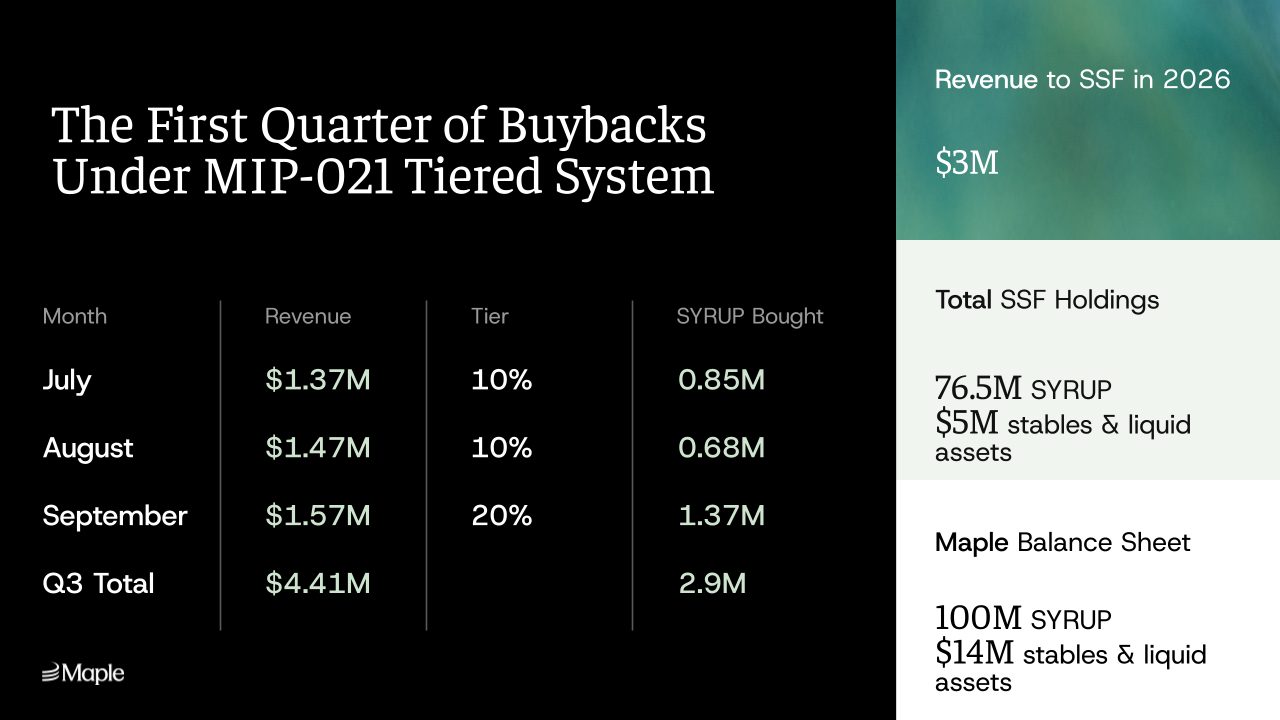
September revenue crossed into the 20% tier, and the SSF bought about double August's amount. Buybacks follow the MIP-021 design. They are not a dividend, distribution, profit share, or guaranteed return.
Henri Arslanian on what holds institutions back
Henri (@HenriArslanian) named career risk as "the single biggest challenge to more institutional adoption." For a pension fund's investment committee, the downside of a digital asset allocation still outweighs the upside, and he argued only time and wider adoption change that. In the full conversation, he also covers what changed at TOKEN2049 this year, where allocators are putting capital, and how US policy could shift after the midterms.
Where the next wave of growth comes from
Sid set out a plan with two sides. Distribution partners bring capital and borrowers Maple can't reach alone. New credit strategies, starting with fintech receivables and lending against rated securities, widen what Maple lends against. Every loan goes through the same underwriting, however fast the book grows.
Sid also set the scorecard Maple will report against every quarter: Loans outstanding, revenue from loan interest, and defaults.
Dates for your diary
- Next AMA: Nov. 11, 2026. Register for the AMA and send your questions ahead of time.
- Next quarterly call: January 2027. Details published nearer the time.
Dave Beach
Editorial & Communications Lead
Dave runs content and communications at Maple, drawing on a decade in fintech and finance. Dave started as a banking trade journalist and went on to build out the content and communication strategies at leading fintechs.